From his beautiful colour palettes, detailed production design, and large ensemble casts, his work is beloved by many
Also, though, his distinct films are not for everyone.
They are quirky, whimsical, dry, and offbeat, and have garnered critical acclaim.
The celebrated director’s latest work, Asteroid City, reunites him with many of his regular collaborators and a few new faces as well.
Yet again, it is another darling little feature from Anderson that has much on its mind, behind the stylised world it presents.
In 1955, students and parents from across the USA gather for scholarly competition at a Junior Stargazer convention held in a fictional American desert town called Asteroid City.
Hope 103.2 is proudly supported by
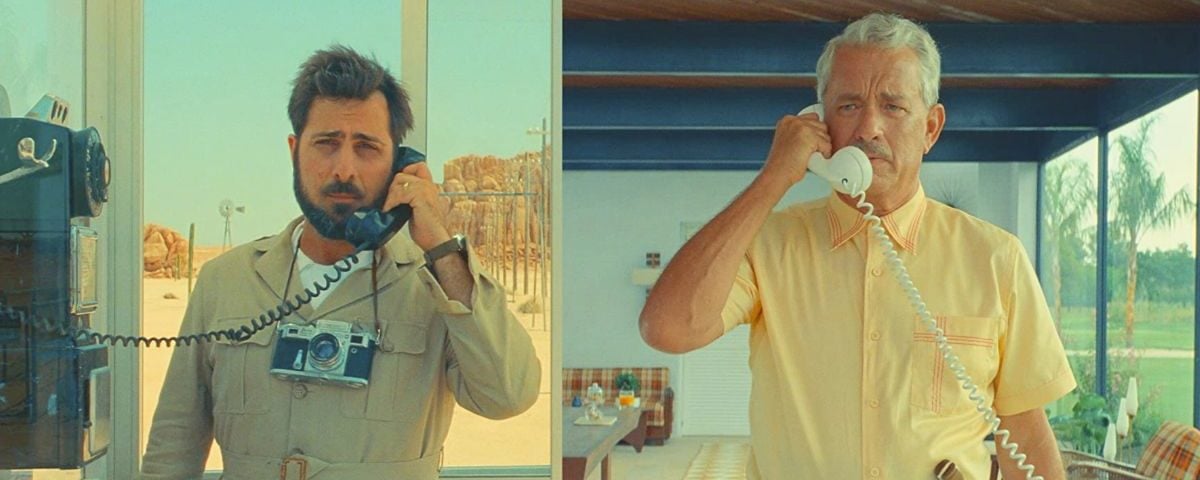
Among the guests are the Steenbeck family, headed by Augie (Jason Schwartzman) who’s wife has just died three weeks prior without his children’s knowledge.
Initially intending to drop his three daughters with his father-in-law Stanley (Tom Hanks) before returning to Asteroid City with his son Woodrow (Jake Ryan), plans go awry when their car breaks down in the town, stranding them.
Augie is forced to call Stanley to come and collect his granddaughters, as he waits with his son for the convention.
Augie meets Midge Campbell (Scarlett Johansson), a Hollywood starlet whose daughter is also one of the competition entrants.
From here, we come to meet an ensemble of the townsfolk, other parents and their children, a band of cowboys, the military sponsors, and a school class on a field trip.
Everything changes when an alien arrives, steals something, and leads to the entire town being quarantined until further notice.
However, the entire story is actually a play that is now having a documentary made about its production, with the two narratives intertwined.

Above: Scarlett Johansson in Asteroid City.
A play within a documentary within a film
This is potentially Wes Anderson’s most meta-narrative film, with the audience watching a play within a documentary within a film.
We are the ultimate observers of a story centred upon observation of the known and unknown as the film ties together the mystery and wonder of science with deep philosophical ruminations on life, death, purpose, and faith.
Anderson and co. ask questions such as “Are we alone in the universe?”, “What will be remembered for?”, “Do we ever really know anything for certain?” and, centrally, “What is the point of my life?”
Schwartzman’s dual role as Augie Steenbeck, and the actor playing him, both have this existential crisis as they seek to understand who they are in the grander scheme of things.
This parallels the group of Junior Stargazers who are coming of age when scientific discoveries are changing the world they live in, as well as how people understand the universe.

Not only is the film bursting with questions, but it is also bursting with colour.
Anderson’s consummate craftwork is an absolute visual delight, and even when the story gets confusing or muddled, audiences will still likely remain engaged by the sheer intricacy of the sets, the stylised cinematography, and snappy score.
The cast is also exceptional, with no weak links among the massive ensemble. Even the smallest roles feel purposeful, and the larger players deliver fantastic well-rounded characters.
Overall, Anderson’s latest work is a delicately layered film that should entertain audiences with its wit, humour, and coming-of-age tale, while also raising deeper existential questions through its framing device, and the broader experiences of its characters.
Reel Dialogue: Is heaven real?

When Augie tells his son Woodrow that his mother has died, he says: “Let’s say she’s in heaven, which doesn’t exist for me, of course, but you’re Episcopalian.”
It’s a line played off for laughs, but it underlines a key theme in a film that focuses so much on life, death, and what exists beyond the stars.
Everyone in the movie finds themselves wrestling with the reality that they aren’t alone in the universe and a feeling they have some greater purpose.
Despite a key character professing to be an atheist, numerous characters – from Stanley, to a student on a school trip – pray at moments in the film.
For the Christian, these existential questions have simple answers.
The Bible clearly teaches about our purpose, origin, Creator, and his Creation, which is the universe and everything in it.
The Bible also teaches us that the things of this world do not last.
Instead, it implores us to look to the Heavens, to our Creator, to find meaning, and everlasting life in his Son, whom he raised from the dead, and who ascended into Heaven and is now preparing a place there for those who believe and trust in him.
Colossians 3:2 – Set your minds on things above, not on earthly things.
Article supplied with thanks to City Bible Forum. If you want to discuss the existential questions posed in this review, reach out to Third Space, who would love to chat with you about this and more.
All images: Movie stills
About the author: Michael Walsh is a Missions Engagement Minister in Sydney, and an avid film fan. His love of film is surpassed only by his love of God, and his desire to make the Gospel known.
Get daily encouragement delivered straight to your inbox
Writers from our Real Hope community offer valuable wisdom and insights based on their own experiences!
"*" indicates required fields
Subscribe + stay connected with all
our latest stories
"*" indicates required fields
Hope 103.2 is proudly supported by
More from Entertainment