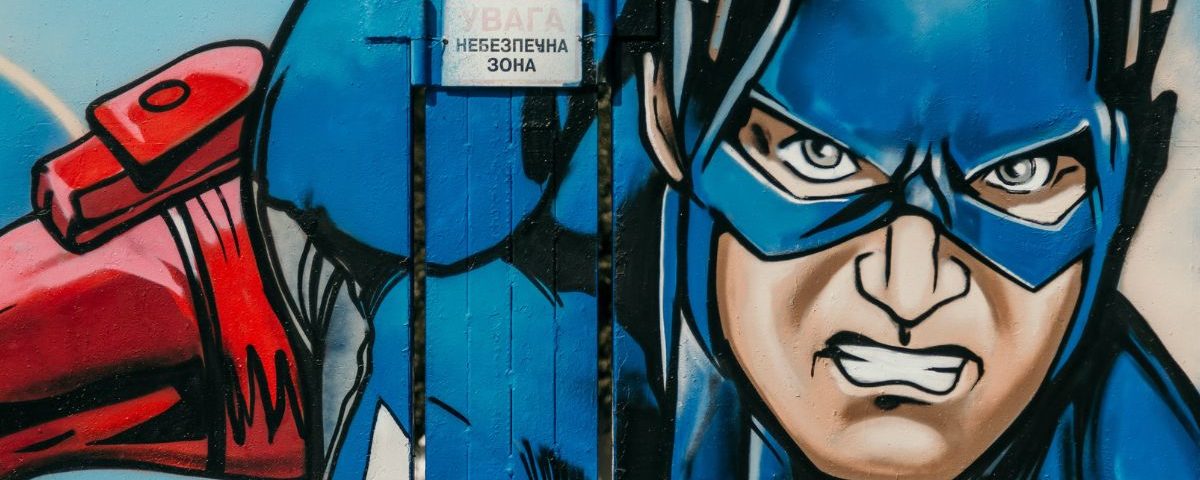
They are part of an elite US Government program – each of them archetypal specimens of human perfection: endurance, power and strength.
Suddenly, the commander throws a grenade into the centre of the group.
The trainees react as expected, instantly scattering – but not Steve Rogers.
He jumps face-down on the grenade, covering it with his chest and yells to the others to run.
The grenade was fake but Rogers had demonstrated a timeless truth.
To be a superhero, you need more than supernatural powers. You need to rescue people.
That moment signified the birth of Steve Rogers as Captain America, the first Avenger and a central player in the ever-growing cohort of superheroes that grace our screens, lunchboxes, t-shirts, video games and most significantly, our imaginations.
Hope 103.2 is proudly supported by
No generation in living memory has escaped the modern cultural infatuation with superheroes.
But why? What is it about superheroes that appeal to us?
When we look a little more closely at the great superhero narratives, some common themes emerge.
The selflessness of Iron Man as he flies weapons of mass destruction beyond the reach of the Earth.
The compassion showed by Superman when – even with his life on the line – it is said of him by his enemy: “He cares. He actually cares for these Earth people.”
The fearlessness of Wonder Woman who fights to protect the human race – even after discovering their inherent capacity for evil – for the sake of their inherent capacity for good.
Superheroes to the rescue
Superheroes offer us a unique combination of inspiration, sacrifice, justice and compassion, all brought together in acts of rescue.
Former US President Bill Clinton put it this way: “We have to reach deep inside to the values, the spirit, the soul, and truth of human nature, none of the other things we seek to do will ever take us where we need to go.”
Perhaps this is where superheroes take us – deep inside ourselves, magnifying the better angels of our nature which we wish would govern our lives and our world.
This mantra of self-sufficiency is one we have taught ourselves for thousands of years.
The sociologists call it self-sufficiency.
The psychologists call it self-actualisation.
The seminal thinker Carl Jung called it individuation.
It is the same idea that underpins so much of the self-help, life-coaching and new-age philosophy we see today.
We are called to look into ourselves and pull ourselves up by our own moral, physical, emotional and existential bootstraps.
The problem is that human effort as the means to human flourishing – as millennia of human history has shown – does not bear witness to reality.
As material, financial, academic and technological prosperity has skyrocketed, the core indicators of human flourishing continue to plummet.
Mental ill-health, suicide, homicide, social exclusion and loneliness are at all-time highs.
It seems we are incapable of living out the virtues we glorify in our superheroes.
Even Mary Poppins – arguably a superhero in her own right – was conceived by her creator PL Travers when she was a young girl.
Travers was kneeling helplessly before a fireplace, amid the trauma of a broken home and an alcoholic father.
She knew then what we all – on some level – know now: Our ongoing search for rescue from within inexorably points to our need for rescue from without.
We are in need of a saviour.
As a cognitive psychologist and musician Daniel Levitin writes, “Artists re-contextualise reality and offer visions that were previously invisible.”
Perhaps this is why every superhero story includes either an implicit or an express acknowledgement of human helplessness and the need for rescue.
But why shouldn’t we just think of superheroes as harmless fictional entertainment?
What’s stopping us from simply enjoying the drama, the virtues, the music, the rescue; and then getting on with our lives?
Well, nothing.
But what if our affinity for superheroes has something deeper to say to us?
What if the ideals we admire most in our superheroes – power, sacrifice, compassion and justice – were brought together in a superhero who actualised them to rescue you and me?
What if the offer of rescue was made outside of the fictional world?
What if our imaginary superheroes were but glimpses of a rescue mission that was not fictional?
To those open to finding answers to these questions, I suggest that your next viewing of a superhero movie be accompanied by a reading of one of the four eye-witness biographies of the life of Jesus Christ.
For the Superman enthusiast, perhaps the Gospel of Matthew.
For Spiderman supporters, perhaps Mark.
For Iron Man followers, perhaps Luke.
For Wonder Woman fans, perhaps John.
Unlike the volatility of the box office after a DC or Marvel film opening, you may find that the good news of Jesus’ offer of rescue delivers on the hopes of the mind and the expectations of the heart.
Article supplied with thanks to City Bible Forum.
About the author: Priyan (Max) Jeganathan is an international speaker and Director of Thinking Faith. He has worked as a lawyer and a political and policy adviser. He is passionate about helping people make sense of current issues through the lens of the Christian message.
Feature image: Photo by Marjan Blan on Unsplash
Get daily encouragement delivered straight to your inbox
Writers from our Real Hope community offer valuable wisdom and insights based on their own experiences!
"*" indicates required fields
Subscribe + stay connected with all
our latest stories
"*" indicates required fields
Hope 103.2 is proudly supported by